

CIP Piping, Valves, and Fittings

Updated: Oct 19
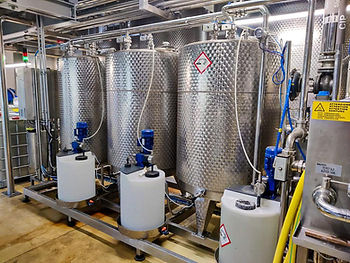
Clean-In-Place is an automated way of cleaning the internal surfaces of process vessels and tubing system without disassembly. This means maintenance labor and time is significantly reduced, while still maintaining high hygiene standards.
The CIP method involves circulating a mixture of water, chemicals, and heat, through the system. Temperatures often reach as high as 90C, and a mix of caustic substances and acids move at speeds fast enough to create a scrubbing effect. Hot water is then used to rinse off the cleaning chemicals before production resumes.
The Infrastructure: CIP Piping

The piping used in any automated cleaning system is sanitary piping, the material will either be SS 304 or SS 316L. High grade stainless steel is used to resist the corrosive chemicals used for the cleaning cycle.
Unlike industrial grade piping, sanitary piping have a smooth internal surface finish of 0.8 Ra or better. The smoothness makes sure that product cannot get hooked to the surface, allowing the strong flow of cleaning agents to wash away contaminants effectively.
The Connections and Junctions: CIP Fittings

Contamination often occur at the connections, and CIP fittings are designed to prevent this. Before sanitary connections, food and beverage manufacturers relied on threaded unions, which are difficult to clean because product tends to get stuck at the threads.
Modern CIP fittings come with the Tri Clamp Unions. These fittings are designed to create a smooth internal surface. When the two ferrules are clamped with a sanitary gasket and tightened, the internal diameter of the fitting perfectly matches the pipe. This eliminates threads or steps, ensuring cleaning fluid reaches every surface.
Flow Control: The CIP Valve

CIP valves do more than just stop flow, they must be drainable. A sanitary valve should not have internal threads or sharp corners. The seals used have to withstand cleaning chemicals without losing integrity too quickly. Most CIP valves can be equipped with actuators, allowing the valves to pulse and increase cleanliness.
A CIP ball valve is a sanitary ball valve with Tri Clamp or weld ends that connects straight into CIP piping. It is widely used for on/off isolation because it gives tight shutoff and, when open, no obstruction or pressure drop. One limit to know: the cavity behind the ball can trap product that CIP flow does not fully reach, even with PTFE cavity fillers, so ball valves in CIP lines are usually dismantled and cleaned by hand at intervals. A two-piece body ball valve has fewer parts and is easier to maintain. Where full CIP cleanability matters, such as dairy and pharmaceutical lines, butterfly or diaphragm valves are usually specified instead. Browse our full range of sanitary valves.
NKE Flow Components supplies CIP piping, CIP valves, CIP ball valves and Tri Clamp fittings from Klang, Selangor, to food, beverage, dairy, brewery and pharmaceutical plants across Malaysia and Singapore. Call 03-3323 5027 or WhatsApp 011-3903 6994 for a quote.


Comments